Replacing my parts boxes with a printed library
Years ago I bought a stack of assortment boxes from Biltema for my electronics parts — resistors, connectors, a few MCUs, and the odd handful of ball bearings that had to live somewhere. They've served me well. The problem is that Biltema stopped selling them, so the day I want to add a box, I can't add the same box.
That bothers me more than it probably should. A storage system you can't extend isn't really a system — it's just the boxes you happen to own. So for a while now I've been quietly stewing on what to replace them with.
The boxes I can't buy anymore
Right now it's about six Biltema boxes holding various components and a growing pile of MCUs, plus the bearings and other odds and ends that ended up in there because they fit. It works, but it's full, and it's a dead end: there's no box number seven to buy.
That left me with two options, and I disliked both. I could buy into an existing commercial system and pray it stays in production — which is exactly the trap I'm already in, just with a different logo on the lid. Or I could 3D print my own, at a potentially higher cost in plastic and a definitely higher cost in time. So naturally I did the responsible engineering thing and didn't decide for months.
Landing on Bookfinity
If I was going to print, Gridfinity was the obvious base layer — it's an open standard, and an open standard can't be discontinued. The harder question was what to put the bins in. There are a lot of Gridfinity holder and drawer styles out there, and most of them are sensible grey boxes that I'd never actually enjoy looking at.
Then I came across Bookfinity: hinged "books" that stand on a shelf, spines out like a real bookcase, and open to hold Gridfinity bins inside. That immediately clicked — storage that looks like a library instead of a parts cabinet.
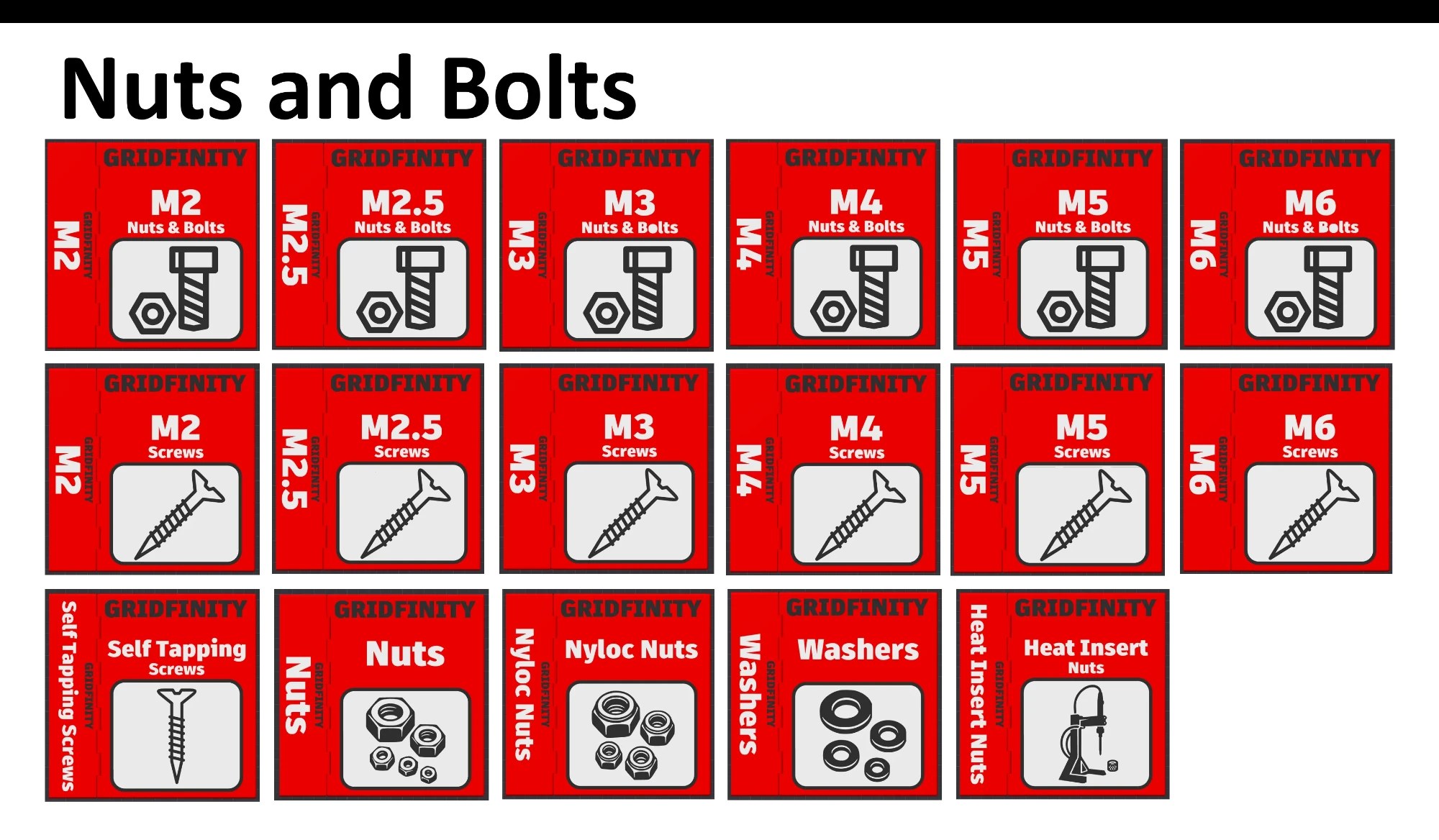
The stock version is fine, but plain — and the ready-made Gridfinity label set that goes with it didn't do much for me either. Functional, a bit charmless; exactly the kind of default look I wanted to get away from.
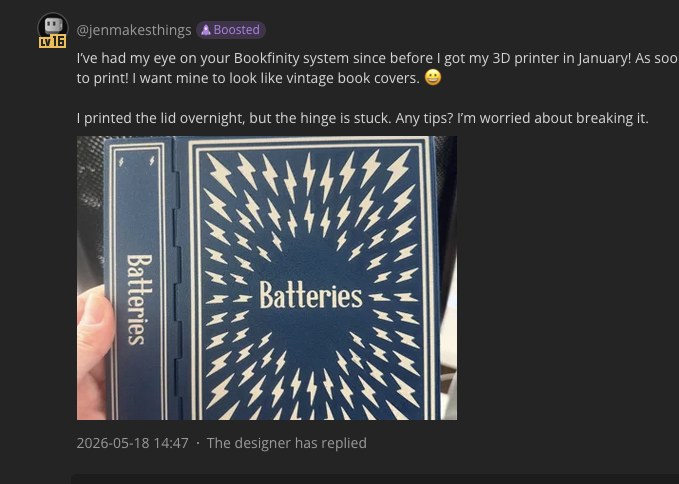
What really got me, though, was a variant someone had posted in the comments: an antique, embossed leather-book cover instead of the plain one — their "Batteries" volume, done up like an old hardback. I was hooked.
So I took that cover design and fed it to nanobanana, asking it to redo the artwork as a nuts-and-bolts theme. Seeing it rendered that convincingly was the moment I actually believed this could look the way I wanted it to — that single image is most of the reason this project exists at all.

The first books off the printer
The part I was nervous about was the hinge. It's printed in place — the two halves and the hinge pin all come off the bed as one moving assembly — and the same threads where I'd found that cover were full of people whose hinges came out fused solid. That "Batteries" post above was someone asking how to free exactly that.
Mine came out moving on the first try, no persuasion needed. I printed it on my Bambu Lab P2S, and the Nuts & Bolts book was the first one off the bed.
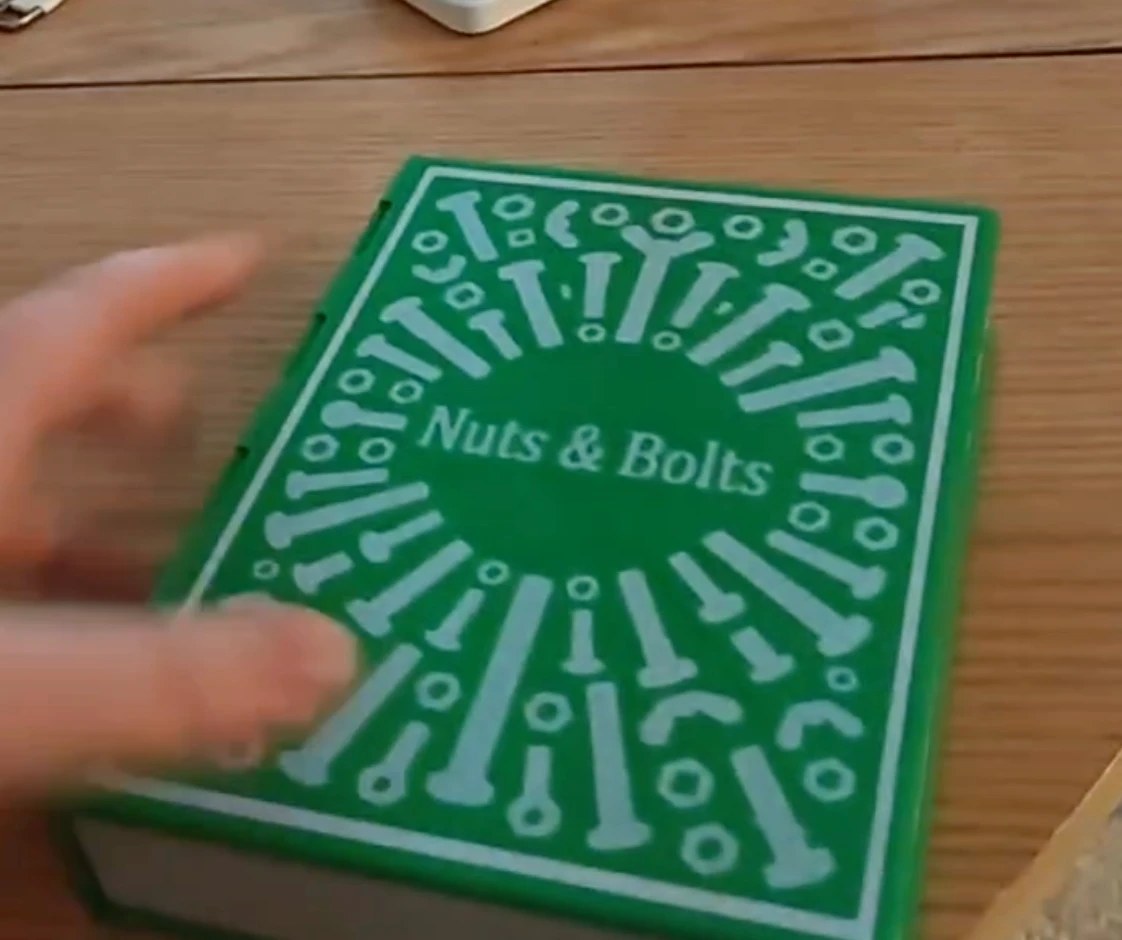
Each book is roughly 250 g of filament. At somewhere between $10 and $30 a kilo depending on which spool I reach for, that's a few dollars of plastic per book — cheap enough that the real cost is print time, not material.
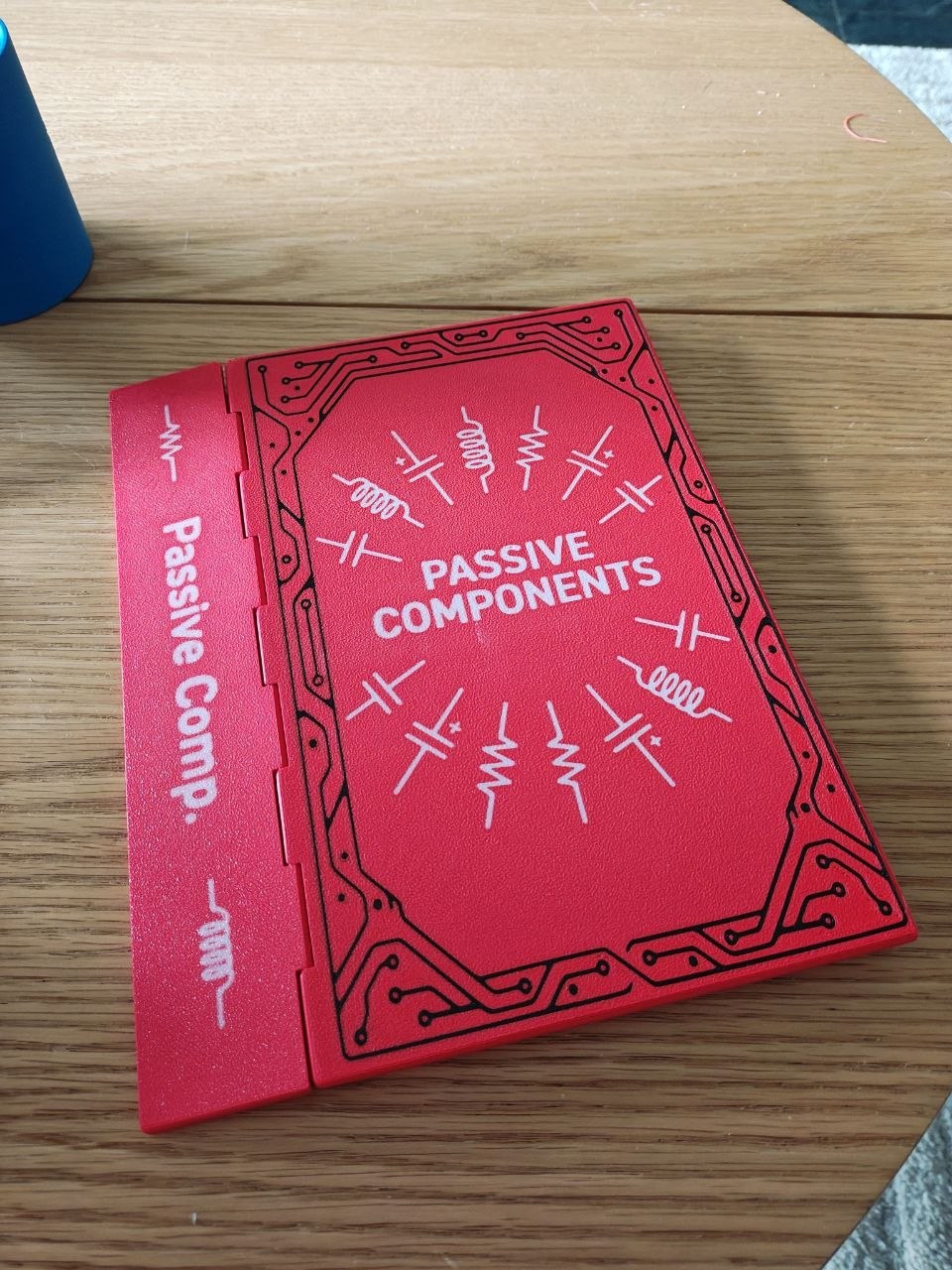
And then, true to form, I sat on it for weeks without printing a single bin. What finally knocked me out of the rut was making a second book yesterday: Passive Components, in red. Two books in, the momentum is back.
| Book | Colour | Filament | Plastic cost |
|---|---|---|---|
| Nuts & Bolts | Green | ~250 g | ~$2.50–7.50 |
| Passive Components | Red | ~250 g | ~$2.50–7.50 |
What's next
The honest status is that I have two very nice books and an empty promise. The actual work now is printing the Gridfinity bins that go inside them — and then more books as the collection grows, migrating six Biltema boxes onto a shelf one volume at a time.
Caveat: nothing has actually moved into a book yet. Right now I own two handsome empty props and a parts collection still living in boxes I can't replace. The point of this entry is mostly to make the slow burn someone else's problem to nag me about.